Translate

Sunday, August 29, 2010

Yoga as a Health Practice


By Sabrina Smith

Yoga has been revered for centuries by many countries of Asia for its ability to heal and promote health and wellness. Some of the countries have derived medical practices that revolve around the key concept of yoga: balancing the mind body and spirit to achieve their goal of health and wellness. India, one of the Asian countries that has been at the heart of yoga for many years, developed the practice of Ayurveda. Yoga and Yogic practices such as meditation, and postures are key to its medicines. Aside from this form of traditional medicine Yoga has been proven to be very beneficial in modern day, curing such ailments like depression, decreasing the risk of heart attacks, stimulating irregular bowls and creating healthy eating habits, helping to release your body from addiction, as well as promote a healthy physical, mental and emotional body.

Ayurveda has been very much a common medicinal practice in India working hand in hand with yoga and it has most recently been made popular by Deepak Chopra, M.D. Chopra explains the methodology of Ayurveda, and its view of the human body as a quantum mechanical device, that is not easily fixed through the prescription of magic pills. But can return back to a balanced state once the body’s energies begin to function in harmony. He explains Ayurveda uses Yogic techniques of mediation to heal the emotional issues such as depression. In his book Perfect Health, Chopra tells a story of a young man whose parents had divorced causing him to fall into a deep depression. When he went off to college the symptoms worsened, causing him to suffer from blindingly severe headaches, acute pain, dizziness and vomiting.


He dropped out of college before the end of the first semester, his father sent him to see a therapist that prescribed him an array anti-depressants. But nothing worked very good or for very long. After a few years of dealing with the depression and thoughts of suicide he had heard about meditation from a friend. The young man began to employ the techniques he learned. He began to find the place deep down inside of him where the headaches and the depression did not dwell. Through continued meditation his small island of awareness slowly became larger, and slowly he began to see his true self that had been hidden underneath the depression and pain (Chopra, 160-63).

The yogic practice of meditation can also reduce the risk of heart attack among those who suffer from borderline hypertension, and high cholesterol. A study conducted at Harvard medical School in 1974 studied twenty-two hypertensive patients. The study showed that the average reading dropped from150/94 to 141/88 it was enough to bring the diastolic pressure (the bottom number) down from borderline to a normal range. However the systolic pressure (the top number) was not lowered enough to be considered normal. However any elevation in blood pressure for an extended period of time can take years off one’s life. So, one might consider the experiment a success (Chopra, 164). Similar experiments to this one have been done regarding patience with high-cholesterol.

Meditation has been used in a study done by two researchers in Israel, M.J. Cooper and M.M. Aygen showed that employing meditation could lower cholesterol. The researchers took a group of 23 patients with elevated cholesterol, twelve were taught meditation and eleven were not. At the end of eleven months they screened their cholesterol again. The twelve that meditated dropped their levels from an average of 255 to an average 225 (the expectable number in the U.S. is 200). This same team did the same study with patience that had normal cholesterol numbers as well. The study showed that cholesterol could be lowered in people who had a normal cholesterol number (Chopra, 164-165). The mind is a powerful device in Yoga and meditation is a showcase of its power at work. However it is not the only device that is activated through yogic practices.

The postures used in Yogic practice as well as the Yogic diet can help to stimulate irregular bowels. Yogic postures give a gentle message to the abdominal viscera, postures like the cat and the plow help to correct constipation, aid in digestion and bowel action (Hewitt, 222 & 244). In regards to the yogic diet, “overeating and underrating are alike detrimental to success in Yoga. A Yogic rule is that one should finish a meal feeling that a little more could have been taken,” (Hewitt, 398). A Yogic diet is considered lacto-vegetarian, not eating meat for ethical as well as health reasons. The yogic diet is further broken down in smaller food groups.

There are particular food groups in the Yogic diet that are considered to influence the human personality, sattvic “pure” food, rajasic “stimulating” food, and “tamasic” impure food. The “pure” foods consist of milk, butter fruits, vegetables and grains. “Stimulating” foods are foods that are stimulating to the nervous system like, spicy, strong tasting foods, meat, fish eggs and alcohol. “Impure” foods are foods that have been putrefied, overripe, rotten or impure in some way (Hewitt 154.) Much of the modern diet consists of these “impure” foods, especially for those who consume meat and processed food.

Have you ever wondered how come meat is not hard and stiff due to rigor mortis, it becomes tender again due to putrefaction, or the decaying process. Much of all food that comes pre-packaged will fall into the category of “impure” due to the additives and preservatives that grace the ingredient list.

According to the Bhagavad-Gita these “impure foods make a person dull and lazy. Their thinking capacity diminishes and they sink almost to the level of animals or bushmen. They have no high ideals or purpose in life; on a physical side, they suffer from chronic ailments of the body,” (Swami Vishnu-devananda, 209). Throughout the practice Yoga one opens themselves up to a new level of awareness in regards to what they put in their body and how it affects them.

“Pure” foods are said to bring purity and calmness to the mind and are soothing and nourishing to the body. Rajasic or “stimulating” foods arouse the animal passion in man and brings a restless state of mind (Swami Vishnu-Devananda, 209).

Beyond the food that we put in our body there are substances that are not only physically harmful to our bodies but are very detrimental to our Being. For instance drugs and the addiction that accompanies them, ranging from nicotine to narcotics cause not only physical harm but disrupt the chemical patterns in bodies. For many, addiction is a hard pattern to break free from. Addiction is like when you manually over ride a program to make it do something out side of its memory. The body has a memory of how the body is suppose to work in a healthy pattern, but the addictive pattern has taken over. Yoga can be used to help restore and remind the body of what the healthy pattern is.


When one begins to practice yoga they begin to open up the chakras in the body, freeing up the energy flow within the body. Yogic postures that are specific to the particular chakra where the addiction is held can be extremely helpful in freeing the body from the addictive pattern. For instance if the addiction rest in the Root Chakra or Muladahar, one would want to practice an asana that would ground them, consisting of seated postures, supine, as well as prone. It is good to have a well rounded set of asana’s so that the chakras do not become over or under stimulated but when you have areas that need focus it is good to give them the attention that they need.

This attention does not only have to be in the form of the physical asana, as mentioned before the mind is a very powerful device and through meditation addictions pattern can be broken as well. This can happen unintentionally. A study done in 1972, by physiologist Robert Keith Wallace, showed that a group of 1,860 mostly college students that began to practice meditation decreased their drug use significantly. After twenty-one months of practicing their drug dependency in the areas of narcotics, barbiturates, hallucinogens, marijuana and amphetamines decreased so much that most had stopped using all together.


Marijuana was still used by about twelve percent and all the others ranged from one to four percent of users. The most interesting part is that they were not part of a rehabilitation program, they were not asked to quit, and the researcher did not follow their progress, nor reward them for abstaining (Chopra, 201-202). It was the mediators’ body coming back into sync, and no longer being part of the addictive pattern.

Yoga as a whole promotes a healthy lifestyle. Yoga makes you more aware of what you are putting in to your body, how you are. Whether you are exercising or not exercising, healthy and un-healthy habits that you have developed in your life, or habits that you hope to develop. Yoga can be used to encourage healing within the body whether it is physical, mental or emotional. This is often through meditation but not limited to meditation. Yogic postures and diet play an integral part in Yoga as a “health practice.”

Work Cited


Chopra, Deepak M.D. “Perfect Health.” New York, Three Rivers Press; 2000.

Hewitt, James. “The Complete Book of Yoga.” New York, Schocken Books; 1977.

Vishnu-Devananda, Swami. “The Complete Illustrated Book of Yoga.” New York,

Three Rivers Press; 1988.

Sabrina Smith is a certified Yoga teacher. She teaches classes in the Oakley, California area.

Saturday, August 28, 2010

Teaching Hatha Yoga – Two Yoga Poses for Stress


By Sanjeev Patel, CYT


It is slowly nearing the beginning of fall in North America. Officially, the fall season will begin on September 22nd, but for some who dislike cooler temperatures, anxiety or stress may follow the summer season. The following two Yoga asanas are easy to practice and help students to release stored energy, which can create bad moods.

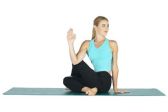
Half Spinal Twist (Ardha Matsyendrasana)

This posture is sometimes called “Half Lord of the Fishes pose.” The name can be traced to Sage Matsyendra. Ardha Matsyendrasana can be confusing to some, but it releases physical tension within the entire body. Physical tension stored at a desk, in a car, and on the couch is a recipe for stress overload.


Directions: Sitting, bend the right knee and place the right foot with the heel against the left buttock. The sole of the left foot belongs on the floor on the outside of the right knee. Bend the left arm behind the back and look out over the left shoulder. The right arm presses on outside of the left thigh and knee, the right hand grasping the inside of the left foot. The twist begins and the sacrum and climbs gradually up the spine to the head. Butt stays firm on the ground, feet stay flat on the floor, toes spread. Spine is straight. Then, alternate sides.


This twisting posture prevents backache and keeps the spine flexible and young. It massages the internal organs, aiding in digestion and detoxification. Like all twisting postures, it has the mental benefit of reminding us that we have the power to unravel ourselves in all kinds of unhealthy situations.


Lion Pose (Simhasana)


Sometimes this asana is called, “Roaring Lion Pose.” For many people, the lion is a favorite Yoga pose. You can perform it silently, but I like to be loud and roar. Sitting with spine straight in Thunderbolt Posture, hands on knees, come slightly forward, roaring and exhaling the lungs completely, while opening the eyes wide (rolled back) and opening the mouth as wide as possible, protruding the tongue out and down as far as it will go.


Hold this position on the exhale for as long as possible (6 seconds) keeping the body tense the whole time. Relax and return to the upright thunderbolt position; breathe normally. Repeat.


This asana tones the muscles of the throat and face, bringing fresh blood and new vigor to those areas. In addition, the psychological effect of this pose cannot be underestimated. It is playful, bringing lightness to the mind when overburdened. It is tense, which leads to better relaxation upon release. It is loud and therefore self-expressive, discouraging shyness.

© Copyright 2010 – Sanjeev Patel / Aura Publications


Sanjeev Patel is a certified Yoga teacher and an exclusive author for Aura Wellness Center in Attleboro, Massachusetts.


FREE Yoga Report. FREE Yoga Newsletter. FREE Yoga Videos. Free Podcasts. Bonus: Free Yoga e-Book, “Yoga in Practice.”


FREE CONTENT: If you are a Yoga Teacher, Yoga studio, blogger, e-zine, or website publisher, and are in need of quality content, please feel free to use my blog entries (articles). Please be sure to reprint each article, as is, including the resource box above. Namaste!

Saturday, April 18, 2009

Hatha Yoga for Personal Growth and Empowerment


By Paul Jerard, E-RYT 500

In Yoga, many students consult their teacher, Guru, or Swami for general advice. These consultations are not always related to Yoga. For the student, the problem is finding reliable advice. He or she listens to the teacher for knowledge and helpful advice. Where can you find concrete advice?
Advice, in and of itself, is a form of connecting personal opinions, personal belief systems, and personal values into a recommendation. Therefore, if you obtain the advice of another, it is his or her personal opinion.
In some ways, each of us would like to resign decision- making to some one else. We want someone, who has all the answers to the riddles of the universe, but we want to have control over our lives. This creates an internal conflict, as most of us want to establish our independence.

Why do we seek the advice of a Yoga teacher, Guru, or Swami? A Guru is a person who is regarded as having great wisdom or knowledge, and uses it to guide others. A Swami is one who knows and is master of herself/himself. In general, these are usually, but not always, Hindu titles of deep respect.

If we think in terms of personal growth, and empowerment, how does one become the knower of herself/himself? To become the master of oneself requires daily regimentation. What you eat, what you read, your daily physical exercise, the time you spend meditating, and much more, are strictly controlled by you. This type of lifestyle requires absolute self-discipline.

Yet, let’s be honest – how many people will ever be able to control themselves at all times? The answer is: Very few. All is not lost if we change, what we can, gradually. To sustain a lifestyle change, requires some planning and to learn to forgive oneself for making mistakes.

Therefore, if you plan to make a big change, start with a few smaller changes, which lead to your eventual goal. For many students of Yoga, they do not see a big change unless they look back in time. The reason is: They started practicing Yoga, adopted healthy habits, and eventually realized the rewards of small steps forward.

To suddenly change everything, all at once, is a shock to your entire being. This is like eating meat and refined “junk food” all your life; then suddenly eating raw vegetables, whole grains, and fresh fruit. The usual result of sudden changes is that we change back to what we were before. To make permanent changes, we must take a moderate and gradual approach.

© Copyright 2009 - Paul Jerard / Aura Publications

Yoga Teacher Certification. FREE Yoga Report. FREE Yoga Newsletter. FREE Yoga Videos. Free Podcasts. Bonus: Free Yoga e-Book, “Yoga in Practice.”

Yoga Classes in Attleboro, Massachusetts, USA

FREE CONTENT: If you are a Yoga Teacher, Yoga studio, blogger, e-zine, or website publisher, and are in need of quality content, please feel free to use my blog entries (articles) - Please be sure to reprint each article, as is, including the resource box above. Namaste, Paul

Saturday, January 31, 2009

Yoga Therapy For Chronic Back Pain - The First Step Toward Relief


By Paul Jerard, E-RYT 500
When considering Yoga therapy for chronic back pain, you should have the endorsement of your physician or medical specialist. Reducing the back pain in your life can be a team effort. It is important to realize that many forms of therapy work well in harmony with medicine and each other.

In the case of Yoga therapy for back pain, one should feel a reduction in pain, but this does not mean you should discard your prescriptions, or the advice of your doctors. Most people, who constantly suffer from back pain, try medical or chiropractic solutions, prescriptions, and a variety of physical or alternative therapies.

After trying a variety of solutions, most people tend to continue with anything that helps them manage, or eliminate, pain. With that said, Yoga therapy sessions, or Yoga classes, are often part of a larger solution for pain management; and in some cases, the complete elimination of back pain.

Does this mean that every Yoga teacher has solutions for backaches and serious back pain? No, because there are a variety of Yoga styles, and many of them address mental, emotional, and spiritual health. Mental, emotional, and spiritual health are important in any healing process, but you want to be sure treatment of the physical body is included in your Yoga therapy.

A smaller, but very popular, group of Yoga styles are off shoots of Hatha Yoga (union by physical mastery). Does this mean that Hatha Yoga is purely physical in nature? No, because depending on the teacher and the sub-style, Hatha also covers mental, emotional, and spiritual health, in various degrees. The variation among Hatha Yoga's sub-styles covers a wide spectrum of knowledge and approaches toward health.

From the Hatha style, modern Yoga therapy has sprung. Among the therapeutic Yoga systems are: Viniyoga, Iyengar Yoga, Restorative Yoga, and other forms of Yoga therapy. This short list is where a person in chronic pain should begin to seek pain management solutions.

This will also require an extensive search for the right teacher, school, or Yoga therapist. The right teacher, or therapist, is knowledgeable, competent, gentle, understanding, and has time for you. You can easily make an assessment in one consultation, private session, or over the phone.
Generally speaking, Yoga schools do not have group therapy sessions for the same ailment.
There may be a specialized workshop for back pain, but these are rare. Therefore, it would be wise to schedule a private Yoga session with the most qualified teacher or therapist you can find.

© Copyright 2008 - Paul Jerard / Aura Publications

Paul Jerard, E-RYT 500, has written many books on the subject of Yoga.
He is a co-owner and the Director of Yoga Teacher Training at:
Aura Wellness Center, in Attleboro, MA. http://www.aurawellnesscenter.com/

He has been a certified Master Yoga Teacher since 1995. To receive Free Yoga videos, Podcasts, e-Books, reports, and articles about Yoga, please visit:

Saturday, December 06, 2008

Yoga Therapy for Chronic Back Pain – The First Step Toward Relief


By Paul Jerard, E-RYT 500

When considering Yoga therapy for chronic back pain, you should have the endorsement of your physician or medical specialist. Reducing the back pain in your life can be a team effort. It is important to realize that many forms of therapy work well in harmony with medicine and each other.

In the case of Yoga therapy for back pain, one should feel a reduction in pain, but this does not mean you should discard your prescriptions, or the advice of your doctors. Most people, who constantly suffer from back pain, try medical or chiropractic solutions, prescriptions, and a variety of physical or alternative therapies.

After trying a variety of solutions, most people tend to continue with anything that helps them manage, or eliminate, pain. With that said, Yoga therapy sessions, or Yoga classes, are often part of a larger solution for pain management; and in some cases, the complete elimination of back pain.

Does this mean that every Yoga teacher has solutions for backaches and serious back pain? No, because there are a variety of Yoga styles, and many of them address mental, emotional, and spiritual health. Mental, emotional, and spiritual health are important in any healing process, but you want to be sure treatment of the physical body is included in your Yoga therapy.

A smaller, but very popular, group of Yoga styles are off shoots of Hatha Yoga (union by physical mastery). Does this mean that Hatha Yoga is purely physical in nature? No, because depending on the teacher and the sub-style, Hatha also covers mental, emotional, and spiritual health, in various degrees. The variation among Hatha Yoga’s sub-styles covers a wide spectrum of knowledge and approaches toward health.

From the Hatha style, modern Yoga therapy has sprung. Among the therapeutic Yoga systems are: Viniyoga, Iyengar Yoga, Restorative Yoga, and other forms of Yoga therapy. This short list is where a person in chronic pain should begin to seek pain management solutions.

This will also require an extensive search for the right teacher, school, or Yoga therapist. The right teacher, or therapist, is knowledgeable, competent, gentle, understanding, and has time for you. You can easily make an assessment in one consultation, private session, or over the phone.
Generally speaking, Yoga schools do not have group therapy sessions for the same ailment.

There may be a specialized workshop for back pain, but these are rare. Therefore, it would be wise to schedule a private Yoga session with the most qualified teacher or therapist you can find.

© Copyright 2008 - Paul Jerard / Aura Publications

——————————————–
FREE Yoga Report. FREE Yoga Newsletter. FREE Yoga Videos.
Free Podcasts. Bonus: Free Yoga e-Book, “Yoga in Practice.”
——————————————–
Yoga Classes in Attleboro, Massachusetts:
——————————————–
FREE CONTENT: If you are a Yoga Teacher, Yoga studio, blogger, e-zine, or website publisher, and are in need of quality content, please feel free to use my blog entries (articles) - Please be sure to reprint each article, as is, including the resource box above. Namaste, Paul
——————————————–

Tuesday, November 25, 2008

Office Yoga - Practice Yoga in Your Office


By Paul Jerard, E-RYT 500

Office Yoga can improve health and productivity. Constant sitting is not healthy for your circulation or for the skeletal structure. Most of us know that excessive sitting can cause poor circulation in the legs and blood clotting.

Yet, many people do not realize excessive sitting can cause piriformis muscle syndrome (a leading cause of sciatica). Some common long-term problems from sitting too much are neck pain, shoulder pain, and chronic joint pain.

Most office workers feel spinal pain in the back, or neck, as a result of prolonged work at computer stations. This can result in absenteeism, as office help takes time to do anything else, but sitting.

If you look around the average office, it is not hard to find signs of over-stretched and weak back muscles from leaning forward. This also results in posture problems we refer to as dowager's hump, the upper thoracic hump, hunch back (kyphosis), and forward head (hyperkyphotic) posture.

Only a few decades ago, these spinal problems were not so commonly seen among younger office workers, because children had more active physical lives. These days, it is not uncommon for a child to come home and do his or her homework on a laptop or PC.

With nearly two decades of an inactive lifestyle, and poor posture, young adults enter the work force to continue unhealthy diet and posture, which will go unnoticed until they experience chronic pain. The solution is to develop office Yoga programs during the course of a day.

The quickest, and least expensive way, to make this change is to bring in qualified Yoga instructors, who can assess daily posture problems and make recommendations for viable solutions. The primary concern here is proper posture and physical activity.

The choices are simple: Compare the cost of higher health insurance, absenteeism, workers' compensation, and temporary disability, to the cost of an independent contractor. Whether a company is large, or small, the advice a competent Yoga teacher will deliver is cost effective solutions for long-term health.

Alternative solutions are the difference between a company's economic survival and going out of business. With rising energy costs, companies are forced to think "outside the box." How many commercial building owners knew or cared about solar shingles, just a few years ago?

The rising cost of labor is much more than an hourly wage. If companies truly see their employees as an asset, office Yoga can raise the level of morale and create a healthier work force. It is up to employers to find less expensive solutions to existing problems or suffer the consequences.

© Copyright 2008 - Paul Jerard / Aura Publications

Paul Jerard, E-RYT 500, has written many books on the subject of Yoga. He is a co-owner and the Director of Yoga Teacher Training at: Aura Wellness Center, in Attleboro, MA. http://www.aurawellnesscenter.com/

He has been a certified Master Yoga Teacher since 1995. To receive Free Yoga videos, Podcasts, e-Books, reports, and articles about Yoga, please visit: http://www.yoga-teacher-training.org/member-offer.html

Saturday, November 08, 2008

Teaching Hatha Yoga - Bhastrika, Kapalbhati, and the Fainting Game


By Paul Jerard, E-RYT 500

Recently, a conversation arose about the dangers of prolonged and forceful Pranayama (Yogic breathing techniques). A friend, and colleague, was discussing pushing the limits of Bhastrika and Kapalbhati to the point of neuron damage, within the brain.

It is true that some Yoga teachers and students are unaware of the dangers of prolonged Bhastrika and Kapalbhati. These two Pranayama techniques are classified as hyper-ventilation. If this means nothing, the short example below will open your awareness to the potential hazards.
When I was a child growing up in the United States, my family moved around the country quite a bit. It was not uncommon for children to play fainting or “passing out” games by practicing hyper-ventilation for prolonged periods of time, until they fainted, which is proven to result in neuron damage within the brain.

Children do foolish things. Luckily, we tired of those games and moved on to less dangerous games. Bhastrika and Kapalbhati are therapeutic when performed in moderation; however, there is a “dark side” of forcing these intense methods beyond the maximum limits.

The dark side is to get brain damage from overdoing something that appears harmless. So, what are the limits of Bhastrika and Kapalbhati? In the case of Bhastrika and Kapalbhati, there is a 10 minute maximum time limit, per day, and per technique, for advanced practitioners, of these two forms of Pranayama.
For healthy beginners, it is better to break up their Bhastrika and Kapalbhati practice into one or two minute segments - with the understanding that 10 minutes total is the absolute limit.
However, some Yoga teachers will tell healthy beginners to stop at five minutes; just to be sure they are not tempted to push their natural limits. If a student begins to feel light headed, he, or she, should take a rest. This is not a contest. For most beginners, we start at one minute, and no more.
Later, we gradually build up the time to 3 or 4 minute segments. It is safer to add one minute segments, with a rest in between the segments. For seniors, in good health, we start at 30 seconds and no more. Later, we gradually build up to one minute, only.
Apparently, the ancient Yogis made a few mistakes along the way, and lost a few practitioners, as a result of overdoing it. I personally love Bhastrika and Kapalbhati, but much like the ocean, these two forms of Pranayama deserve respect.

To make it crystal clear: The path of moderation, which is also known as the “Middle Way,” is the safest of all the paths. In Yoga, and in life, there should never be extremes, even when our egos are tempted to push the maximum limits.

© Copyright 2008 – Paul Jerard / Aura Publications

——————————————–
FREE Yoga Report. FREE Yoga Newsletter. FREE Yoga Videos.Free Podcasts. Bonus: Free Yoga e-Book, “Yoga in Practice.”
——————————————–
Yoga Classes in Attleboro, Massachusetts: http://www.aurawellnesscenter.com/
——————————————–
FREE CONTENT: If you are a Yoga Teacher, Yoga studio, blogger, e-zine, or website publisher, and are in need of quality content, please feel free to use my blog entries (articles) - Please be sure to reprint each article, as is, including the resource box above. Namaste, Paul
——————————————–

Saturday, May 31, 2008

Yoga Instructor Certification - How To Become A Certified Yoga Instructor At Home


Written By Karina Sinclair


In recent times yoga instructor certification has become more important than ever. In the past registration was usually enough because the practice and teaching of yoga was not as mainstream as it is today. However nowadays not being certified puts a yoga teacher at serious risk of costly lawsuits and unable to obtain liability insurance at all.


The Major Reason For Certification


The major reason for becoming certified is for a teacher's legal protection. There has unfortunately been an increase in lawsuits against teachers as a result of student injuries that usually could have been avoided with proper training and instruction.


While one's first impression of yoga is that it is a relaxing, spiritual exercise it can actually be quite vigorous, especially for people who are just starting out or seniors.


Why Injuries Usually Occur


Unfortunately if students have not stretched adequately enough before the lesson or have done a move incorrectly inadvertent injury may occur.


How being certified will help you is that it will be a lot easier for you to obtain liability insurance. Liability insurance is not something that should ever be overlooked, no matter how experienced you think you may be or how safe and gentle you believe your class is.


Get To Know Every Student


A student questionnaire is highly recommended because it is essential as their teacher that you understand every student's overall health, medical conditions, fitness level and general history.
Teachers who have been teaching for an extended period of time may not have had any kind of certification available to them. That's why it's essential even the most seasoned trainers ensure that their are covered.


On a positive note, if you are a professional teacher you may be able to receive some sort of credit or recognition for your past experience and your training already undertaken.


The Minimum Certification Requirement


There is a minimum requirement and that's 200 hours of study. What must be included in any course you undertake is virtually every facet of running a yoga business including anatomy, physiology, safety, modifications and contraindications.


Additional Benefits


You will find it easier to obtain work if you are certified. In fact, some studios for their own protection consider it a hiring requirement.


Yoga instructor certification is now easier than ever with the range of certification home study courses. To save you time I have spent hours researching the range of instructor certification courses available and have announced my number one choice at my yoga training website.


Yoga Master With 5000 Hours Of Training Under His Belt Teaches Future Yoga Instructors How They Can Earn $150.00 Per Hour As A Professional Yoga Instructor And Be Certified Within Just 3 Months In His World Class Yoga Teacher Training Course Online.


Start your certification today at http://www.yogainstructorscoursecertification.com/

Thursday, May 22, 2008

Kapalbhati, The 10 Minute Yoga


Written By Shalini Singh


Kapalbhati is one of the best yoga techniques that have been given to us by sages of India. It is a gift to humanity. The idea is simple, breathe in normally and exhale forcibly allowing the stomach to collapse. Do it for 10 minutes and feel the difference within days.

Kapalbhati is one of my favorite pranayamas. Kapalbhati is a subcategory of Pranayama that comes in the 3rd chapter of "Pantajali Yogdarshan". Amongst the several Pranayamic exercises and techniques; Kapalbhati is noteworthy as Kapalbhati is an exercise the practice of which imparts glow to the skull; a cleansing process which brightens the forehead. Kapalbhati is a pranayama technique which invigorates the entire brain and awakens the dormant centers that are responsible for subtle perception.

Although performing kapalbhati is basically quite straight forward, it is important that it is performed correctly in order to obtain the best results. It includes breathing slowly as usual and then forcing the breath outside. A major effect of kapalbhati is to increase air pressure in short bursts in the nasal pharynx and sinuses, which stimulates the forward part of the brain.
However, if both nostrils are blocked, Kapalbhati cannot be done. The technique uses short and strong forceful exhalations while inhalation happens automatically.

Kapalbhati is theretofore a highly energizing abdominal breathing exercise as it causes the stomach to collapse as the exhalations are forced. Kapalbhati is a highly energizing abdominal breathing exercise. Kapalbhati could be done as fast as two strokes in a second. Kapalbhati is the one major yogic breathing technique capable of expelling toxins from the lungs. Though kapalbhati is usually done sitting down, it can be practiced standing up.

This pranayama technique actually invigorates the brain and cleanses the mind. I think Kapalbhati is the one that helps me most. Baba Ramdev is a great proponent of the Kapalbhati and suggests at least 10-15 minutes a day to get rewards.

S. Singh is great fan of Baba Ramdev and has been following his yoga for several years specially Kapalbhati.

Sunday, May 18, 2008

The Yoga Mat and Other Yoga Props


Written By Sarah Russell


If you're just beginning your yoga practice, don't be frustrated if you aren't as strong or as flexible as the more advanced students. This type of flexibility is developed over time with continued yoga practice. If you're having trouble completing some of the poses, consider using props to help you reach the correct position. Using yoga props helps support the muscles and minimize strain so that you can continue practicing without injuring yourself.

Yoga props can also help elderly people and those with medical ailments to exceed their limitations, providing support and enabling them to perform the poses they would not normal be able to do. Of course, you don't need to invest in any expensive equipment to practice yoga - you can do it naked in your living room without any fancy gear. However, if you're just getting started, these props can make your yoga practice much more enjoyable and rewarding.

Mats: The yoga mat is one of the most important yoga props. Yoga mats are also called sticky mats - and that's what they do! When used on a hard floor surface, the mat will stay in place, giving you the traction you need to perform the poses. Even when you start to get sweaty, your hands and feet won't slip. The mat also gives your knees a little cushion when you're kneeling on a hard surface.

Mats aren't expensive - you can pick up a good one for under $30 and it'll last a long time. If you're just starting at a gym, they'll probably have some that you can borrow. However, out of hygienic concerns, get your own and bring it with you. You don't know who used that mat before you!

Blankets: Some studios will provide blankets for students to use during practice. If you're having trouble performing some seated poses, you can fold them up and sit on them, changing the angle of the pose and improving alignment. They're also great for covering yourself up during the final corpse pose - you'll be so much more relaxed when you're warm and toasty under your blanket.

Straps and Blocks: Yoga straps and blocks are also handy tools to have when you're just starting out. Both can be used to modify poses to make them easier if you aren't that flexible yet. If you're taking an introductory class, ask the teacher to help you use them throughout the class. He or she will be able to recommend the best way to modify poses with these props.

Attire: You might not think of your workout clothes as props, but what you wear can have a huge impact on how well you practice. You don't need to invest in a certain brand or specific article of clothing, but you should make sure that your attire is comfortable and breathable. Women, also consider a form-fitted top for yoga practice. Sometimes your head ends up lower than your hips which can cause your top to slide down.

Want to learn more about how yoga can change your life? Check out Sarah Russell's new book - The Beginner's Guide to Yoga and Meditation - at:
http://www.mind-body-connection.com/
-------------------------------------------------
Attleboro Yoga / Pilates Schedule

Ending: June 26, 2008

Holidays: May 26, 2008 - Memorial Day - There will be no class on this day.

Spring Class Schedule:

Monday: 6 PM - 7:15 PM Beginner / Gentle Yoga
Tuesday: Private Sessions by Appointment Only
Wednesday: 6 PM - 7 PM Pilates / Body Sculpt
Thursday: 6 PM - 7:15 PM Beginner / Gentle Yoga
Friday: Private Sessions by Appointment Only

Saturday, May 17, 2008

Hatha Yoga Benefits


Written By Sarah Russell


Hatha Yoga is descended from a 5,000 year old system of movements and meditations meant to improve the health of the body, mind, and spirit. It's made up primarily of a series of stretching exercises known as asanas, combined with breathing techniques and methods of concentration. You're probably familiar with the classic Lotus position, which is one of the basic meditative positions in Hatha Yoga.

The main goal of Hatha Yoga is much the same as other forms of yoga practice. It attempts to blend the spirit of the individual with the greater spirit of the universe, improving the health of the spirit, mind, body and emotions. Hatha Yoga has been said to help practitioners attain inner peace and a feeling of oneness with the universe. Remember that no matter what type of yoga you choose to perform, concentration is a very important factor.

All types of yoga have some similarities. However, they differ in methods or intent in other areas. Hatha Yoga's main focus is the preparation of the body, so that the spirit will be able to perform its function in bringing the practitioner to enlightenment. A great deal of confusion can arise, as many people don't realize that it's important to have a healthy, fit body in order to successfully attain spiritual enlightenment.

Hatha Yoga practice is applied to the body in order to strengthen it and the spirit inside. Its physical techniques are often used by people who aren't interested in spiritual advancement, but who would like to receive the physical benefits of Hatha Yoga as well. This is the most commonly taught form of yoga, and is thus the type that comes to most people's minds when yoga is mentioned. Other styles of yoga, some of which are derived from Hatha Yoga, include Kundalini, Bikram, Ashtanga, and Power Yoga.

In addition to the physical benefits of Hatha Yoga, there are also mental ones. It's been said to assist in the development of greater concentration and focusing abilities, in addition to reducing stress and anxiety. For many people, this is an important benefit, and something they need in their lives. If you're being distracted and need some time to relax, Hatha Yoga might be the right solution.

For those who are looking for a spiritual benefit, Hatha Yoga allows you to find your own divine light. It can help you become stronger, more flexible, and more relaxed. Performing Hatha Yoga allows the energy of your spirit to flow more freely, since the mind, spirit, and body are more closely in harmony. If your body is weakened, this weakness also affects the mind and spirit. Skeptical? Consider how hard it is to concentrate when you have a headache.

Practicing Hatha Yoga can help you cope with stress, and can relieve some of your tension and pain. If work is leaving you exhausted, you need to find time to relax and rejuvenate yourself. Hatha Yoga is an excellent remedy, that can help you release built up worries and anxiety.

Want to learn more about how yoga can change your life? Check out Sarah Russell's new book - The Beginner's Guide to Yoga and Meditation - at:
http://www.mind-body-connection.com/

Friday, May 16, 2008

Understanding Yoga Techniques


Written By Sarah Russell


If you're practicing yoga, understanding and applying techniques properly is very important. Yoga can be an important part of an overall campaign to improve your health, since exercise is a big part of preventing disease and staying healthy.
It's one of the most effective methods, since it puts little strain on the body, and provides many other health benefits. It's also easy to practice yoga wherever you are, since it requires no special equipment. You can do it at home or away, at whatever time you choose. Many people prefer yoga as their method for living a healthy, happy life.

Yoga can help you maintain good internal health, including good circulation, healthy organs, glands and other tissues, as well as providing strength and flexibility to muscles, connective tissue and joints. It's also been said to help relieve stress and improve concentration. Many people also use yoga as a way to attain spiritual fulfillment.

There are plenty of yoga techniques available. However, there are a few that are very effective, no matter where you are or when you'd like to practice. Here are five basic yoga techniques that form the foundation of many others. They are: relaxation, posture, meditation, joint movement, and deep breathing. Every technique performs its own function in concert with the others, to produce the desired effect.

In Sanskrit, the movement of the joints is referred to as "sandhichalana". This yoga technique, as the name implies, focuses on the joints, which undergo full movements. It's important to remember that this applies to all joints, from the hands to the neck and lower limbs.

Relaxation is composed of a number of other yoga techniques to help you improve your concentration, allowing you to focus your attention more effectively. It can also help reduce stress and anxiety. For instance, the Hong-Sau is a technique meant to help focus your latent powers of concentration, and to develop your Divine Consciousness. The familiar Aum technique uses simple repetitive sounds to expand awareness beyond the body's limitations. It can help you stay in a meditative state for longer periods, and is said to open the practitioner to experiences of the Divine.

Remember that not all yoga techniques are suitable for the beginner. If you're just starting out, you may have trouble with some advanced poses. Talk to your instructor, or try modifying them to make them easier to do. Be sure to stay aware of your body, and figure out what feels right and what makes you feel tense or in pain. Try to release tension, and allow calm relaxation to take over.

Remember that one of the main objectives of yoga is creating a satisfying feeling of relaxation. It's important to find out how to effectively release your tension, allowing you to feel better and to be healthier. The help of a good yoga instructor can help you do this more effectively, and with less trial and error. Then, once you've mastered the basic yoga techniques, you'll have no problem going on to practice on your own.

Want to learn more about how yoga can change your life? Check out Sarah Russell's new book - The Beginner's Guide to Yoga and Meditation - at:

----------------------------------------
Attleboro Yoga / Pilates Schedule

Yoga & Pilates - Spring Session (2008)

Ending: June 26, 2008

Holidays: May 26, 2008 - Memorial Day - There will be no class on this day.

Spring Class Schedule:

Monday: 6 PM - 7:15 PM Beginner / Gentle Yoga
Tuesday: Private Sessions by Appointment Only
Wednesday: 6 PM - 7 PM Pilates / Body Sculpt
Thursday: 6 PM - 7:15 PM Beginner / Gentle Yoga
Friday: Private Sessions by Appointment Only

Wednesday, May 14, 2008

Yoga Types - Which One is Right for You?


Written By Sarah Russell


With all the different types of yoga in existence today, choosing the right one can be hard for a beginner. It's important to choose the variety of yoga that's right for you in terms of fitness level, your spiritual and physical goals, and you health. Here are a few of the most common types of yoga to help you pick the best one for you and your situation.

Iyengar Yoga: This type of yoga focuses on precise movement and the alignment of the body. It often uses straps, blocks, and other props to help less flexible beginners perform the same movements as experts. These items can also help people with injuries adapt movements to their individual bodies. This allows everyone to perform yoga poses with comfort.

This type of yoga pays a lot of attention to detail, but poses are flexible and can be modified, making it a good choice for people who suffer from neck or back pain. Adjusting the poses can also help people with other injuries. Iyengar Yoga is a good choice if you'd like to get a good basic knowledge of classic yoga poses, giving you the fundamental for other types of yoga later on.

Teachers of Iyengar yoga are likely to focus on inner awareness and alignment. Inner awareness begins with the body, but then moves to other parts of ourselves as we continue with practice on a regular basis.

Ashtanga Yoga: This type of yoga has also been referred to as "power yoga". This is because flowing, powerful movements are a big focus of this discipline. Lunges, pushups, and other stamina- and strength-focused movements that aren't usually associated with yoga may be involved. People who are looking for a more challenging practice, or are looking to build strength after overcoming injuries, particularly to the back, may wish to practice this type of yoga.

If you're already fairly athletic, but want to add more balance to your routine than running, cycling, or working at the gym can provide, Ashtanga Yoga may help you. It can help you improve your concentration, and build muscles you don't normally use.

Bikram Yoga: This yoga type is also called hot yoga. This is because its chief feature is being performed in an extremely warm room. Heat can help tissues to stretch, making this kind of yoga a good tool for increasing your flexibility. However, if you have a heart problem or other cardiovascular disease, the warmth of the room in which Bikram Yoga is performed can be dangerous, because it places extra strain on this system.

Viniyoga: This type of yoga links breathing and flowing movements into individually adapted exercises. If you have a back problem or neck injury, this variety of yoga might be a good fit, as it's easily adapted to each person.

Raja Yoga: Designed to liberate the mind through meditation, this type of yoga works well for people who are interested in engaging in intense concentration.

Bhakti Yoga: A form of devotional yoga, this practice focuses on the surrender of the self in the face of the divine.

Mantra Yoga: Known also as the "yoga of potent sound", this practice focuses on the liberation of the mind via the repetition of sounds which have power. "Om" is the most familiar, but other mantras include "ram" and "hum".

There are plenty of different types of yoga to pick from. Before you join a class, talk to your teacher and find out his or her philosophy of yoga and beliefs on the subject. This will help you decide if the type of yoga is a good fit for you.

Want to learn more about how yoga can change your life? Check out Sarah Russell's new book - The Beginner's Guide to Yoga and Meditation - at:

Tuesday, May 13, 2008

Yoga Mat - All You Should Know About A Yoga Mat


Written By Bertil Hjert


When practicing yoga, you need to make certain investments. These investments would do a lot for your flawless performance, benefits that you obtain from performing various asanas and overall health.

One of the most important investments you require to make even before you start off with your program of doing yoga is purchasing a yoga mat. This is one of the most crucial investments you need to make.

A) The mat is beneficial to you in the following aspects:

a) It prevents you from falling and provides you good amount of grip.

b) It provides you safety and it lets you perform all the asanas without any difficulty.

c) It allows you to stay away from sweat and the distraction caused by sweat while performing yoga.

d) A yoga mat provides good support for your back when you lie down.

e) The yoga mat lets you perform all your asanas just the way you should.

B) There are several things you need to consider prior to purchasing a yoga mat. This will make sure that you have made the best possible deal:

a) Learn

Try to gain sound knowledge on different types of yoga mats available. You need to know what material these are made of, what each mat specializes in and how they differ from each other.

b) Research

In order to get the best deal, you need to do a little bit of homework on your side. Try to make a good research on various shops selling yoga mats, the quality they deal in and prices each dealer offers you. Compare and then make a choice.

c) Comfort level

When choosing yoga mat you must see your comfort level. Check out whether your height and width fit well into the mat you are planning to purchase. The yoga mat should be able to provide proper grip and lay flat on the ground. Don't buy if it sticks to your feet when you lie down.

d) Allergies

Latex yoga mats are very popular and most commonly used. However, if you are allergic to latex products, simply stay away from it.

e) Don't fall for cheap options

Don't purchase a yoga mat just because it offers you good amount of discounts. Purchase a yoga mat only if it fulfills all your needs and specific yogic requirements.

f) Ask your instructor

If you are learning yoga from an instructor, ask him to provide superb tips for purchasing a yoga mat. He would be the best person to provide you great suggestions.

g) Look for these basic points

Make sure that you look for the basic points when purchasing a yoga mat.

1. Health and environment safe

2. Durability and comfortability

3. Accepted by your teacher

4. Non-slippery and light and easy to roll up

h) Tests

Here are some tests that would prove useful for you when purchasing a yoga mat.

a) The Quarter test

The edge of a quarter will tell you a lot about its durability. The more the strokes, the longer will be the life of yoga mat.

b) The wet friction test

Just wet your hands and bear down laterally on the mat surface. This will let you compare wet traction.

c) The pinch test

Just pinch the mat between thumb and forefinger and you will come o know about compression resistance.

For more Articles, News, Information, Advice, and Resources about YOGA and MEDITATION please visit YOGA TIPS and MEDITATIONBUZZ

---------------------------------------------------------------

Attleboro Yoga / Pilates Schedule

Yoga & Pilates - Spring Session (2008)
(37 Available Classes)
Beginning: April 2, 2008
Ending: June 26, 2008
Holidays: May 26, 2008 - Memorial Day - There will be no class on this day.
The Spring Yoga / Pilates Session starts on April 2, 2008.
Spring Class Schedule:
Monday: 6 PM - 7:15 PM Beginner / Gentle Yoga
Tuesday: Private Sessions by Appointment Only
Wednesday: 6 PM - 7 PM Pilates / Body Sculpt
Thursday: 6 PM - 7:15 PM Beginner / Gentle Yoga
Friday: Private Sessions by Appointment Only
30 Classes = $240
20 Classes = $180
10 Classes = $ 97
Walk-in Rate: $15

Sunday, May 11, 2008

On-Site Yoga Teacher Training - Attleboro, MA


The Aura Yoga Teacher Training is currently in progress at our Attleboro, MA facility, located at 21 Park Street, Suite 202, in downtown Attleboro.
Experienced Yoga teachers, Yoga teacher interns, and serious students, may attend any Yoga teacher workshops (see schedule).
Fall 2008 - Spring 2009

Our next Yoga teacher training camp begins on September 5, 2008. Candidates should have, at least, two years of steady training in Aura's Restorative Hatha Yoga Style or comparable training within a similar style. Restorative Yoga is a gentle style that fits the needs of everyone.

Client safety is our number one concern.

We meet the 200 hour Yoga Teacher requirements, and contact hour guidelines, set by Yoga Alliance. The teacher trainer is Paul Jerard, E-RYT 500.


Yoga Teacher Training classes meet on Fridays from 6:00 p.m. to 9:00 p.m. and Saturdays from 9:00 a.m. to 4:30 p.m.

You should make a commitment to be at all of the teacher training classes and go through an internship. Level I Yoga teacher training is based on 200 hours of intensive study within the many aspects of Hatha Yoga.

Some flexibility can be built into your Yoga Teacher internship, based upon hours with your mentor and teaching Yoga classes. We will cover this on orientation night or you can call ahead.

Telephone 508-222-0092.

This Yoga certification program includes hands-on development with Paul Jerard, the director of Yoga teacher training, independent research, and the home-study of teacher texts. We adhere to the International standards for Yoga teacher training hours.

All Yoga teacher training sessions are held with Paul Jerard, E-RYT 500.


Technical Training, Features, and Course Benefits

Eighteen (18) intensive sessions
Eighteen (18) more hands-on classes to develop your teaching skills
Guidance during your internship
Practical Exam
Written Exam
Syllabus
Kriyas
Asanas
Modifications for Asanas
Yoga philosophy & Yoga Teaching Methodology
Assisting with Asana alignment
Working with special populations
Chair Yoga & Office Yoga
Yoga for Seniors & Yoga as Therapy
Using Yoga Props
The Pilates Connection to Yoga
Yoga Teaching Tips
Yoga Business Development
Yoga Teacher Marketing
Networking with Yoga Teachers
Anatomy
Kinesiology
Prenatal & Postnatal Yoga
Communication with Yoga Students
Chakras
Bandhas
Mudras
Yamas, Niyamas, and Yoga Sutras
Pranayama Methods
Meditation Methods
Relaxation Techniques
Yoga teacher Ethics
Benefits of Teacher's Training
Continued Technical Support
Certification
AURA Teachers Training Materials worth $497.00
Three Foundational Yoga Teacher Training Texts
Free Liability Insurance for classes you teach at AURA
Job placement, as it becomes available
Many more Free Yoga Teacher Handouts
Business & Marketing Materials

In 2007: This training was sold out by July.

Total Cost (Due at Time of Registration):

Early Bird Pre-registration by June 1, 2008 for only: $2000
Pre-register by July 1, 2008 for only: $2100
Pre-register by August 1, 2008 for only: $2200
If any space is available, at the door: $2300.

Installment plan will be scheduled as follows:

$600 down payment
$600 due October 7, 2008
$600 due November 7, 2008
$600 due December 7, 2008

To receive an application, to attend your Teacher Training Course, please Email us.
This is the most reasonably priced, and comprehensive Yoga Teacher Training Program, in the Southeastern New England area.
Space is limited to 12 candidates.

Wednesday, November 14, 2007

Yoga Myth - Advanced Physical Prowess


By Paul Jerard

There are many myths which surround Yoga. Most of them are circulated by people who have never practiced Yoga of any kind. Yet, there are some myths about Yoga, which have been accepted as fact, by Yoga practitioners. It is difficult to shatter an "urban legend, but let's look at one of them.

"An advanced Yogi can perform amazing postures and feats of physical prowess."

While this can be true, and Hatha Yoga practice can lead to physical mastery, feats of physical prowess can be performed by young people, who never practiced any form of Yoga before. Please bear in mind that there are many forms of Yoga, which are not based upon physical exercise.

Bhakti Yoga, Jnana Yoga, and Karma Yoga, are primary forms of Yoga, which have advanced practitioners, who do not have to perform physical feats to be known as "advanced." Mohandas Karamchand Gandhi, was an advanced Karma Yogi, who inspired non-violent civil rights movements within India, and around the world.

The flaw in all of this "labeling" of Yoga practitioners as advanced, intermediate, and beginner, stems from the idea that Yoga is a physical exercise. Pilates and weight lifting are physical exercise systems, and they require a mental presence in their practice. All forms of Yoga require a mental, physical, and spiritual presence in the practice.

Hatha Yoga (union by physical mastery) does not represent all forms of Yoga. If Hatha Yoga were the only style in existence, it still would require teachers with experience and deep knowledge on a vast subject.

Any child can perform amazing athletic feats of flexibility, but would you place your absolute faith in the ability of a child to teach you Hatha Yoga? Would you be concerned about your safety, your physical limits, and the teacher's experience level?

"Experience" is a keyword, because experience is what really separates the advanced Yoga practitioner from the rest. An experienced Hatha Yoga teacher will guide you through the many aspects of Yoga, such as: Asana, Meditation, Pranayama, Mudra, Bandha, Yama, Niyama, and much more.

If you are practicing in a Hatha Yoga class, which contains postures, but does not contain meditation or Pranayama, you are probably practicing "Yoga Fitness." There is a saying: "Half a loaf is better than none." This has never been truer than it is in the case of Hatha Yoga's exposure to the world.

It may take generations before Yoga practitioners stop to read the Hatha Yoga Pradipika by Swami Swatmarama. The Yoga Sutras, by Maharshi Patanjali, also deserve more contemporary attention. At this time, there are many Yoga books to read, but the classics are worthy of note, and should be "required reading" for advanced Yoga practitioners.

© Copyright 2007 - Paul Jerard / Aura Publications

Paul Jerard, E-RYT 500, has written many books on the subject of Yoga. He is a co-owner and the Director of Yoga Teacher Training at: Aura Wellness Center, in Attleboro, MA.


He has been a certified Master Yoga Teacher since 1995. To receive a Free Yoga e-Book: "Yoga in Practice," and a Free Yoga Newsletter, please visit:

Friday, May 25, 2007


By Paul Jerard, E-RYT 500


Yoga, in all of its forms, creates positive energy. Positive energy will cause you to become successful, and live a life where powerful visions become reality. Your complete health will improve exponentially, as a result of regular Yoga practice.


Yoga has so many good health aspects for a person to benefit from. Yet, some people see it only as a “workout,” and as a result, Yoga has become classified, in the west, as an exercise. Although Hatha, Kundalini, and Raja Yoga contain many breathing exercises (Pranayama) and postures (Asanas), Yoga is not merely another physical exercise system.


Hatha Yoga is the most popular form of Yoga outside India. Hatha Yoga is also known as the unity of mind, body, and spirit, through physical mastery. The initial results of regimented Hatha Yoga practice are physical fitness, motivation, clear thought, and increased energy.


There are many more benefits from long-term Hatha Yoga practice. If I could make a “Hatha Yoga Pill,” I would be a billionaire! When some people hear the words, “physical fitness,” they think of torture, so they avoid Yoga of any kind.


Yet, the masses will gladly spend billions of dollars on ineffective, over the counter drugs, fad diet products, ineffective exercise gadgets, and life endangering pills, to try to manage their body weight.


So, a Hatha Yoga pill, with no side effects, would “sell like hot cakes.”


However, the Hatha Yoga pill is only part of my imagination and the dream of “couch potatoes.” Yet, couch potatoes do not have to worry because Yoga is not physical fitness, but it is complete health on the physical, mental, spiritual, and emotional planes of existence.


The benefit of motivation from Yoga practice is what makes Yoga so different from all other health maintenance systems. Yoga can become a lifestyle because there is no torture.


Why do most diets fail? Why do most exercisers quit? Lack of motivation is the reason for diet and exercise failure. People already know they should eat better, walk more, exercise, and drink more water, but they need to maintain their level of motivation, without “burning out.”


In Yoga practice, positive energy is all around the classroom. Positive energy creates motivation and creates powerful visions of success. The next step is to believe the powerful visions of success, which you see.


Some people have a fear of success. Maybe they inherently feel a lack of self-worth, but Yoga also works on improving this aspect of life. It is normal for people to feel apprehensive about change, but change is often one of the gateways to success.


Lastly, regular Hatha Yoga practice will lower stress levels, allowing you to sleep better, and feel energized the next morning. No wonder Yoga teachers and students are so full of motivation.


© Copyright 2007 – Paul Jerard / Aura Publications
--------------------------------------------

Attleboro Yoga & Pilates Classes - June Schedule

--------------------------------------------


Dear Yoga & Pilates Enthusiasts of Attleboro,


Below is our June 2007 - Yoga / Pilates Class Schedule:


Each month the Tuesday night class will show case a different class. There will be no Tuesday classes in July.


Monday: 6 PM – 7 PM Beginner / Gentle Yoga


Tuesday: 6 PM – 7:15 PM - Introduction to Yoga on the Ball *


Wednesday: 6 PM – 7 PM Pilates/ Body Sculpt


Thursday: 6 PM – 7:15 PM Beginner / Gentle Yoga


Tuesday Night Classes will become the featured class of the month.


*Starting June 5, 2007, Introduction to Yoga on the Ball, will meet on Tuesdays at 6:00 p.m.
This class will focus on firming the mid-section, toning the body, enhanced coordination, and improving balance.


All Yoga and Pilates Classes at Aura Wellness Center will be closed for the first two weeks of July 2007.


The next Aura Yoga Teacher Training will be held in our Attleboro, MA facility, located at 21 Park Street, Suite 202 in downtown Attleboro.


Orientation night for Yoga teacher training will be Friday, September 7, 2007 at 6:00 p.m.


Aura Wellness Center

21 Park St.Suite 202, 2nd Floor

Attleboro, MA 02703
Phone: 508-222-0092
--------------------------------------------

Attleboro Yoga Lessons: http://www.riyoga.com

--------------------------------------------

Wednesday, February 14, 2007

Why Yoga Exercises Are Different From Other Forms Of Exercise

By Nelly Luprimo

If you are thinking of taking up a form of exercise with the aim of making yourself look and feel much better you should give very serious thought to yoga exercises.

Yoga works holistically on the body and mind and so its positive effects can be seen in many different aspects - on our bodies, their health and how they look, and also on our minds - in how we view the world.

So how do yoga exercises differ from other forms of exercise?

Yoga exercises, also known as asanas or postures, are applied to the entire anatomy of the living body. On the other hand, many other exercise regimes are a form of engineering applied to the muscles of the body. This means that yoga exercises are concerned with more than just the superficial development of muscles. The postures used in yoga exercises tend to normalize the functions of the entire organism.

The advantage of yoga exercises is that they can regulate the involuntary processes of respiration and help the circulation, digestion, elimination, metabolism etc. The yoga exercises also work to affect the working of all the glands and organs, as well as the nervous system and the mind. This result is achieved by doing deep breathing while the body is placed in various postures. Each of these yoga exercises creates a different totality in the functional relationship within the organism.

Hence, yoga is able to influence man physically, mentally, morally and spiritually. Yoga emphasizes the philosophy of exercise. Under its training one experiences a sense of awakening.

All of one's capacities are heightened, and one achieves balance and stamina through these yoga exercises, some of which are modeled after the movements of various animals. In yoga exercises, relaxation is taught as an art, breathing as a science, and mental control of the body as a means of harmonizing the body, mind, and spirit.

The advanced stages of yoga require many years of special preparation-practices. Today's mode of living , its tempo and surroundings, mean that this is difficult to achieve. However, practicing yoga exercises and deep breathing and relaxation techniques, with some of the time devoted to concentration and meditation is something everyone can achieve.

Yoga exercises can have a positive effect on individuals who are suffering from disease or illness. Whilst it is not able to cure these things, practicing yoga can means that obstructions and impurities are removed so that nature can perform its healing work.

So if you are looking for a form of exercise that works positively on the body and mind, and one that is relatively easy to fit into your daily routine then why not take up yoga exercises. The growing popularity of yoga exercises means that you will likely find a yoga center or a gym offering local classes in your area. If, however, you do not have time to attend classes there are many books and dvd's available on yoga exercises, so you can do it at home at a time when it is convenient to you.

Within only a few days of performing yoga exercises it is possible to feel revitalized and stronger. Continued practice of yoga exercises can make us healthier and happier.

Author Nelly Luprimo spreads the message of yoga through her online yoga community - www.blackyogamat.com

Thinking of taking up yoga? Then you should visit Nelly's website by clicking this link ...Yoga Exercises.
--------------------------------------------
Attleboro Yoga & Pilates Classes - February / March Schedule
--------------------------------------------
Dear Yoga & Pilates Enthusiasts,

Below is our February / March 2007 - Yoga / Pilates Class Schedule:

Monday: 6 PM – 7 PM Beginner / Gentle Yoga
Tuesday: 6 PM – 7:15 PM Vinyasa Yoga
Wednesday: 6 PM – 7 PM Pilates/ Body Sculpt
Thursday: 6 PM – 7:15 PM Beginner / Gentle Yoga
Saturday: 11:30 AM – 12:30 PM Yoga / Pilates Body Sculpting

Chakra Workshop is Friday, March 30, 2007 - 6 to 9 p.m.

Aura Wellness Center
21 Park St.Suite 202, 2nd Floor
Attleboro, MA 02703
Phone: 508-222-0092
--------------------------------------------
Attleboro Yoga Training: http://www.riyoga.com
--------------------------------------------

--------------------------------------------
How to Become a Certified Hatha Yoga Instructor
--------------------------------------------
FREE Yoga Report. FREE Yoga Newsletter.
Bonus: Free Yoga e-Book, "Yoga in Practice."
http://www.yoga-teacher-training.org/docs/Yoga-in-Practice-eBook.pdf
Visit: http://www.yoga-teacher-training.org
Affiliates: http://www.yoga-teacher-training.org/signup.html
Sister Blog: http://yoga-teacher-training.blogspot.com/
On-Site Training: http://www.riyoga.com
--------------------------------------------

Saturday, January 20, 2007

Hatha Yoga’s Attraction for Middle-Aged Students


By Paul Jerard, E-RYT 500

Why are more, and more, students, over 40 years of age, discovering Hatha Yoga classes for the first time? What can Hatha Yoga do for a “couch potato?” What can Hatha Yoga offer the active person, who is over 40? Let’s take a closer look at each of these issues for the deeper answers, which Hatha Yoga contains.

There are many styles of Yoga, and Hatha Yoga is just one of the nine main styles from India. Hatha Yoga has many sub-styles, such as: Vinyasa Yoga, Restorative Yoga, Iyengar Yoga, Kripalu Yoga, and many more. Before we go too deeply into this subject, please realize that outside of India, the most common form of Yoga is Hatha Yoga.

Why are more students over 40 discovering Hatha Yoga classes for the first time?

Recently, I’ve seen an influx of Yoga students, at our Attleboro Yoga Studio, who have been inactive for decades, but decided to make a “life change” to improve their health. As a result, they become physically active in Hatha Yoga classes and continue to practice their Yoga training at home.

Some of our new Yoga students arrive, due to a physician’s referral, but many have researched Yoga. Their research caused them to make an independent decision to improve their health on a mental, physical, spiritual, and emotional level.

As we approach middle age, body weight is harder to get rid of than it ever was. As a result, this extra weight can bring us many health problems and diseases.

In fact, shedding 10 or 20 pounds of body weight may just extend your life span. Heart problems, high blood pressure, diabetes, some forms of cancer, and more diseases, prey on those of us who carry extra pounds around.

So, we are not considering living at a nursing home for an extra decade, but increasing our odds to have an active and quality life to the end.

What can Yoga offer the active person, who is over 40?

For those of us who have been exercising for decades, we realize there is a flaw in the “No pain, no gain” theory. Premature joint wear is the biggest problem. For most of us, recognizing the difference between muscular and joint pain comes with age.

Therefore, the new fitness motto for middle age should be, “Work smart, not hard.” This requires a bit of research, as to which style of Yoga is most suited to your body and then finding a compassionate Yoga teacher. One class can tell you if the style is to your liking. As for Yoga teachers: It is easy to recognize a Yoga teacher who is abusive from one who is not.

However, some people are very attracted to a Yoga teacher who will “push them.” Be careful if you fall into this category. A Yoga teacher is not a coach, whose goal is to push you to the next competitive level.

It is fine to have goals in life, but take the time to research your individual needs. Make sure the Yoga teacher, and the Yoga style, you choose will fit into your lifestyle. Yoga’s principles are more about training for longevity than training for a short-term gain.

© Copyright 2007 – Paul Jerard / Aura Publications

--------------------------------------------
How to Become a Certified Hatha Yoga Instructor
--------------------------------------------
FREE Yoga Report. FREE Yoga Newsletter.
Bonus: Free Yoga e-Book, "Yoga in Practice."
http://www.yoga-teacher-training.org/docs/Yoga-in-Practice-eBook.pdf
Visit: http://www.yoga-teacher-training.org/
Affiliates: http://www.yoga-teacher-training.org/signup.html
Sister Blog: http://yoga-teacher-training.blogspot.com/
On-Site Training: http://www.riyoga.com/
--------------------------------------------
FREE CONTENT: If you are a Yoga Teacher, Yoga studio, blogger, e-zine, or website publisher, and are in need of quality content, please feel free to use my blog entries (articles) – Please be sure to reprint each article, as is, including the resource box above. Namaste, Paul
--------------------------------------------

Friday, January 05, 2007

The Benefits And Joys Of Yoga


By Peter Curtis

There are a lot of people who are crazy about yoga. The reason why most people do yoga is that it makes them feel better and in shape. The different poses and postures make their body healthy. Yoga for most is the best way to relax and unwind. If you want to keep your body in shape, this might be the best exercise for you. Did you know that yoga is good to fight certain illness that may come? There had been researches which proved that yoga helps you to control anxiety, reduces asthma, arthritis, blood pressure, back pain, multiple sclerosis, chronic fatigue, epilepsy, diabetes, headaches, stress and many more.

Yoga has a lot of benefits and advantages. All in a day’s work, it can reduce tension and stress. Of course after a heavy day, you will feel that your muscles have been stuck up and you will feel wasted. If you do yoga, your self esteem will be higher. It is important to gain more confidence inside and out so that you can face people with no worries. Yoga is good for the body in increasing your muscle tone, strength, stamina and flexibility.

If you are too fat and conscious about your body figure, yoga can help you lower your fat and keep your body in shape. Yoga exercises can burn excess fat and give you the desired figure that you want. If you need time to relax and forget your responsibilities, yoga will be good to improve your concentration and enhance your creativity. Yoga helps you to think more positively away from all anxieties. If you have a fresh mind, you can think of good things and apply it easily.

Your body needs to relax once in a while. Sometimes, work can leave us wasted and exhausted. During the heavy days, we may not find time to unwind because work is still on our tail. Yoga can help you create a sense of calmness and well being.

Yoga exercise helps you improve a good circulation. Your organs and veins need to be exercised for it to function properly. Yoga can help stimulate your immune system and keep you away from diseases. If you have a good immune system, you can be sure that you are free from sickness. Some people do yoga to be enlightened. They believe that yoga will help them bring up their spirit and keep them relieved. Yoga works differently for people be it spiritual, emotional, psychological, mental and physical.

People think that yoga is only for spiritual people. But that belief is wrong. Even if you are not that religious, you can do yoga. You will see and feel the difference at the same time find out how it works for you. Due to the pressure and demands of life, we become stressed out and we forget the essence of life. We tend to lose touch with the ones we used to spend time with, even ourselves. We find ourselves rushing most of the time with the deadlines and hassles we need to keep up with. This leaves us a small time to wander and have that physical awareness. These are the few things that yoga can provide. Once in a while, find time to dedicate a part of it to yourself to relax and unwind which only yoga can give.

Peter Curtis is a full time aerobics instructer in Las Vegas. In his spare time he writes articles andguides for various website and online publications. You can visit one of his website about the Yoga here. http://www.aerobics-exercise.com/Yoga.html

--------------------------------------------
How to Become a Certified Hatha Yoga Teacher
--------------------------------------------
FREE Yoga Report. FREE Yoga Newsletter.
Bonus: Free Yoga e-Book, "Yoga in Practice."
http://www.yoga-teacher-training.org/docs/Yoga-in-Practice-eBook.pdf
Visit: http://www.yoga-teacher-training.org
Affiliates: http://www.yoga-teacher-training.org/signup.html
On-Site Training: http://www.riyoga.com
--------------------------------------------